
Buying a car in the UAE means choosing between two very different paths: a brand-new vehicle with full warranty and zero history, or a used one that costs less upfront but comes with its own risks and rewards. Both options are popular across Dubai, Abu Dhabi, and Sharjah — but the right choice depends on your budget, how long you plan to keep the car, and how much risk you’re comfortable taking on.
This guide breaks down the real differences in cost, depreciation, financing, and ownership experience, so you can make a decision that fits your situation rather than a generic recommendation.
Quick Answer
If you want predictability, the latest tech, and a full manufacturer warranty, buy new. If you want to avoid the steepest depreciation hit and get more car for your budget, buy used — ideally a car that’s 2–4 years old with full-service history and, if possible, remaining warranty coverage.
Key Differences at a Glance
| Factor | New Car | Used Car |
| Upfront cost | Highest | 20–50% lower for similar spec |
| Depreciation | Steepest in year 1 (often 20%+) | Already absorbed by previous owner |
| Warranty | Full manufacturer warranty (3–5 years typical) | May have remaining warranty or none |
| Financing rates | Generally lower interest rates | Slightly higher rates, shorter loan terms |
| Insurance cost | Higher (comprehensive, higher vehicle value) | Lower premiums |
| Condition/history | Zero wear, no unknowns | Depends on previous owner, accident/service history |
| Registration & RTA/MOI fees | Standard new registration | Ownership transfer fees apply |
| Customization | Latest trims, colors, options | Limited to what’s available on the market |
| Resale value later | Drops fastest early on | Depreciation curve is flatter |
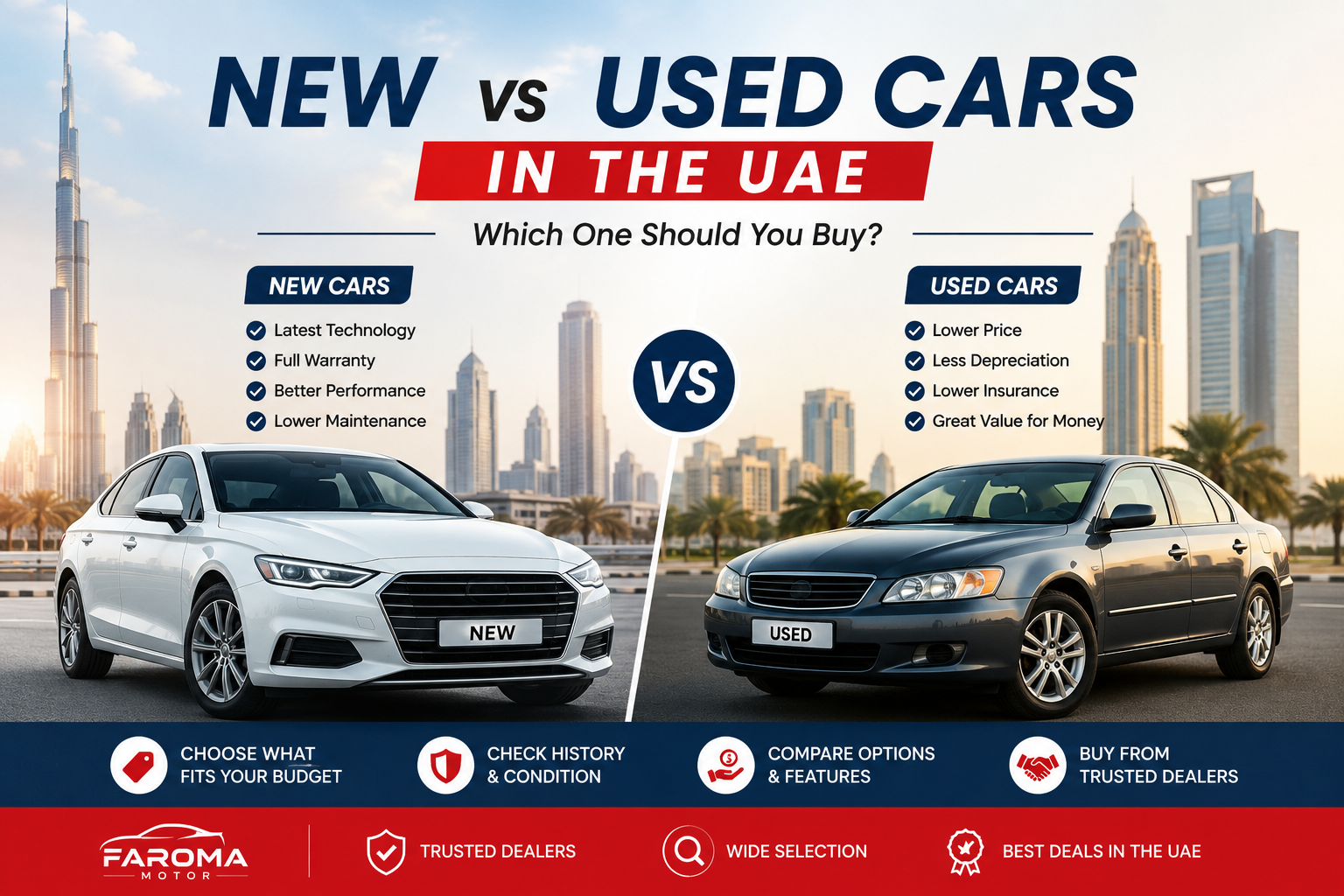
The Case for Buying New
1. Full Manufacturer Warranty
New cars in the UAE typically come with 3 to 5 years of warranty coverage, and often free scheduled servicing for part of that period. This matters a lot in a climate that’s hard on engines, AC systems, and tires — unexpected repair bills are largely avoided.
2. No Unknown History
There’s no risk of hidden flood damage, poor maintenance, high mileage, or accident repairs. In a market with a large number of imported and re-exported used vehicles, this certainty has real value.
3. Latest Safety and Tech Features
Newer models generally include better driver-assistance systems, updated infotainment, and improved fuel efficiency — features that can be a meaningful gap in older used models.
4. Better Financing Terms
UAE banks generally offer lower interest rates and longer loan tenures on new cars compared to used ones, since the asset holds more collateral value.
5. Dealer Support
New cars purchased from authorized dealers usually come with access to dealer service centers, genuine parts, and sometimes free roadside assistance for the warranty period.
Trade-off: You absorb the sharpest depreciation of the car’s life. Many models lose 15–25% of their value in the first year alone.
The Case for Buying Used
1. Lower Upfront and Total Cost
A 2–3 year old car can often be purchased for 30–45% less than its original price, while still offering most of the features of the newer model.
2. Slower Depreciation From This Point Forward
Since the steepest depreciation already happened, a used car retains value more predictably going forward — useful if you plan to resell in a few years.
3. Lower Insurance Premiums
Insurance in the UAE is largely based on the vehicle’s declared value, so a used car generally costs less to insure comprehensively.
4. Wider Choice for the Same Budget
The same money that buys a base-spec new car can often buy a higher trim, larger engine, or more premium brand in the used market.
5. Certified Pre-Owned (CPO) Programs
Many dealerships in the UAE (Al-Futtaim, Al Tayer, AGMC, and others) now offer certified pre-owned programs with inspection reports and limited warranties — narrowing the risk gap with new cars.
Trade-off: You inherit whatever wear, maintenance gaps, or accident history the car has — unless you’re buying certified or thoroughly inspect it yourself.
Costs to Compare Beyond the Sticker Price
When comparing new vs used, look at total cost of ownership, not just the purchase price:
- Registration and transfer fees — used cars require an ownership transfer fee through the RTA (Dubai) or relevant traffic authority, typically a few hundred dirhams.
- Insurance — get quotes for both scenarios before deciding; the gap can be significant on premium models.
- Financing cost — compare the total interest paid over the loan term, not just the monthly installment.
- Maintenance — new cars under warranty often include scheduled service; used cars may need immediate maintenance catch-up.
- Resale value in 3–5 years — some brands (Toyota, Lexus, Nissan) hold value better than others regardless of new or used status.
How to Reduce Risk When Buying Used in the UAE
- Run a vehicle history check through the RTA or a paid report service to check for accidents, mortgages, or outstanding fines.
- Get a pre-purchase inspection from an independent garage or a service like those offered by RTA-approved centers.
- Verify the service history — ideally full dealer service records.
- Check for remaining manufacturer warranty, which can sometimes transfer to a new owner.
- Buy from a licensed dealer or certified pre-owned program rather than an unverified private seller if you want more protection.
- Confirm the car isn’t salvage, flood-damaged, or grey-imported without proper compliance documentation.
Who Should Buy New?
- First-time buyers who want zero risk and full warranty peace of mind
- Buyers who plan to keep the car 5+ years and want to maximize warranty coverage
- Buyers who qualify for strong financing rates and want the latest safety tech
Who Should Buy Used?
- Budget-conscious buyers who want more car for the same money
- Buyers who plan to resell within a few years and want a flatter depreciation curve
- Buyers comfortable doing due diligence (inspection, history check) or buying certified pre-owned
Frequently Asked Questions
Is it better to buy a new or used car in the UAE?
It depends on your priorities. New cars offer warranty coverage and zero history risk but lose value fastest in year one. Used cars cost less upfront and depreciate more slowly from the point of purchase, but require more due diligence.
How much do new cars depreciate in the UAE?
Many new cars lose roughly 15–25% of their value in the first year, and can lose 50% or more within the first three to four years, though this varies significantly by brand and model.
Are used cars in the UAE reliable?
Reliability depends heavily on the individual car’s history, mileage, and maintenance record — not simply its age. A well-maintained 3-year-old car with full service history is often more reliable than a poorly maintained one-year-old car.
Is financing easier for new or used cars?
New cars generally qualify for lower interest rates and longer repayment terms from UAE banks, since lenders view them as lower-risk collateral.
What is a certified pre-owned (CPO) car?
A CPO car has passed a dealer’s multi-point inspection and typically comes with a limited warranty, offering a middle ground between the cost savings of used and the assurance of new.